Showing posts with label Navarathri recipes. Show all posts

August 22, 2019

Kalkandu (Rock Sugar) Pongal

How to make Kalkandu (Rock Sugar) Pongal


            The jaggery pongal is quite popular & well liked by everyone, but the kalkandu pongal is kind of like the shy cousin of the jaggery pongal. Many may not have tasted it and hence not know about this less known , but equally delicious pongal version. The recipe was duly noted in my recipe diary cos' my grandma & mom used to make this pongal occasionally. To make this pongal taste rich, I have used evaporated milk instead of regular. Sharing this divine recipe with my friends at Sri Valli's CCC# 41: February -- Week 2.


Ingredients for 6 to 8 servings:

uncooked rice - 1 cup
Pasiparuppu/Moong dal - 1 tbsp
Kalkandu/Rock sugar - 1.5 cups
Evaporated milk or regular milk - 1 cup + 2 tbsp
Elakkai podi/Cardamom powder - 1/4 tsp
Nutmeg powder - 1/8 tsp
Ghee - 3 tbsp
Saffron - a pinch
Raisins - 1 tbsp or more
Cashewnut - 2 tbsp


Pressure cooker method:

  • In a pressure cooker, cook (until soft & mushy) the rice & dal together with 1 tbsp of ghee, and excess water. (ex: if you normally add 2.5 cups of water for 1 cup of rice; add 3 cups of water instead).
  • Soak the saffron in 2 tbsp of warm milk.
  • When the rice is cooked, add the kalkandu/rock sugar to it, stir to let it melt in the heat. Add the milk & stir on low heat, taking care not to burn it.
  • Add cardamom and nutmeg powder. Add the soaked saffron to the pongal.
  • In a separate pan, melt ghee & fry the cashewnuts & raisins. Toss them into the pongal & serve hot or cold.


October 28, 2018

Nuts & Wheat Ladoo

How to make Nuts & Wheat Ladoo


              Also known as Atte ka Ladoo in Hindi (can also be made without nuts) is a simple Indian sweet made with basic ingredients from our pantry. A great after workout snack or a health-boosting dessert alternative. They make great homemade treats instead of store-bought processed snacks. These delicious balls are jam-packed with flavor and nutrients. These ladoos being high in calories are great for kids to keep their energy levels up any time of the day.


Ingredients for about 40 ladoos:


whole wheat flour - 3 cups
Cashew nuts - 1/2 cup
Pistachios - 1/4 cup
Almonds - 1/4 cup
(superfine) Sugar - 2 cups
Cardamom powder - 1/2 tbsp
melted ghee - as needed to make ladoos


Stove-top method:

  • Dry roast all nuts in low flame for 2-3 minutes, until the raw smell disappears. Let it cool down & powder them finely and set aside.
  • Dry roast the wheat flour on low heat until it loses its raw flavor and smells aromatic. 
  • If your sugar is not super fine, you may powder it before adding it to the flour.
  • Add the powdered nuts, sugar, cardamom powder to the roasted flour, and mix it well. Melt ghee on low flame & keep it warm, until you finish making all ladoos.


  • Take a small batch of the flour mix, pour a ladle full of hot ghee, stir & make balls using your hand. Repeat the process until all of the flour has been turned into ladoos. 
  • Store in air-tight container & enjoy with your family & friends.

Sharing my mom's recipe from my recipe diary with my friends at CCC #59 Oct Week 4.


October 21, 2018

Cashew Badam Halwa


How to make (quick & easy) Cashew Badam Halwa

    
             Although I did not have a sweet tooth during childhood, I have always been a sucker for milk sweets - Bengali sweets being my most favorite, followed by 'Thirattu Paal' and 'Paal Khoa'. When I moved to this country and felt deprived of my favorite sweets for a long long time and store-bought sweets weren't as good as the ones you get in India, I had to find a way to satisfy my craving. At first,  I added sugar to the unsweetened store-bought khoa to make 'Paal Khoa' and that was delicious by itself. After a few times, I decided to up my game by adding powdered nuts to this concoction and thus ended up with the 'Ultimate Paal Khoa'. Since then, I never went back to the regular Paal khoa. I had found my "soul-food"! The only drawback being, that this is super rich & will take a toll on your weight :o). To control my temptations, I only make it during Diwali season every year and, yes I do go overboard during Diwali time anyways... and end up blaming the festive season by calling it holiday weight gain.

           It takes only a few minutes to make this deliciously sweet halwa, but it tastes royal. I'm sorry, I'm raving so much about this halwa. My opinions might be biased as I love milk sweets, so why don't you try this easy peasy recipe this Deepavali to make your family & friends happy; that is if you have any leftovers to share ;o)


Ingredients:

2.5 cups/12 oz/350 Gms Unsweetened Khoa
2 Cups Sugar
1/2 Cup Cashew powder
1 Cup Badam
Milk - 1 Cup
a few strands of saffron


Stove-top method:


  • Grate the Khoa with a peeler or chop it up into smaller pieces. Powder the raw nuts as desired.
  •  Heat the milk with the Khoa. Once the Khoa blends with the milk, add the powdered nuts & sugar. Heat on low-medium & keep stirring until you reach halwa consistency. Top it with saffron strands & serve warm or cold.

Sharing my recipe with my friends at CCC #59 Oct Week 3. Do check out their latest Diwali recipes as well for more inspiration this season.

November 19, 2017

Quick Sunflower seeds Ladoo

How to make Sunflower seeds Ladoo


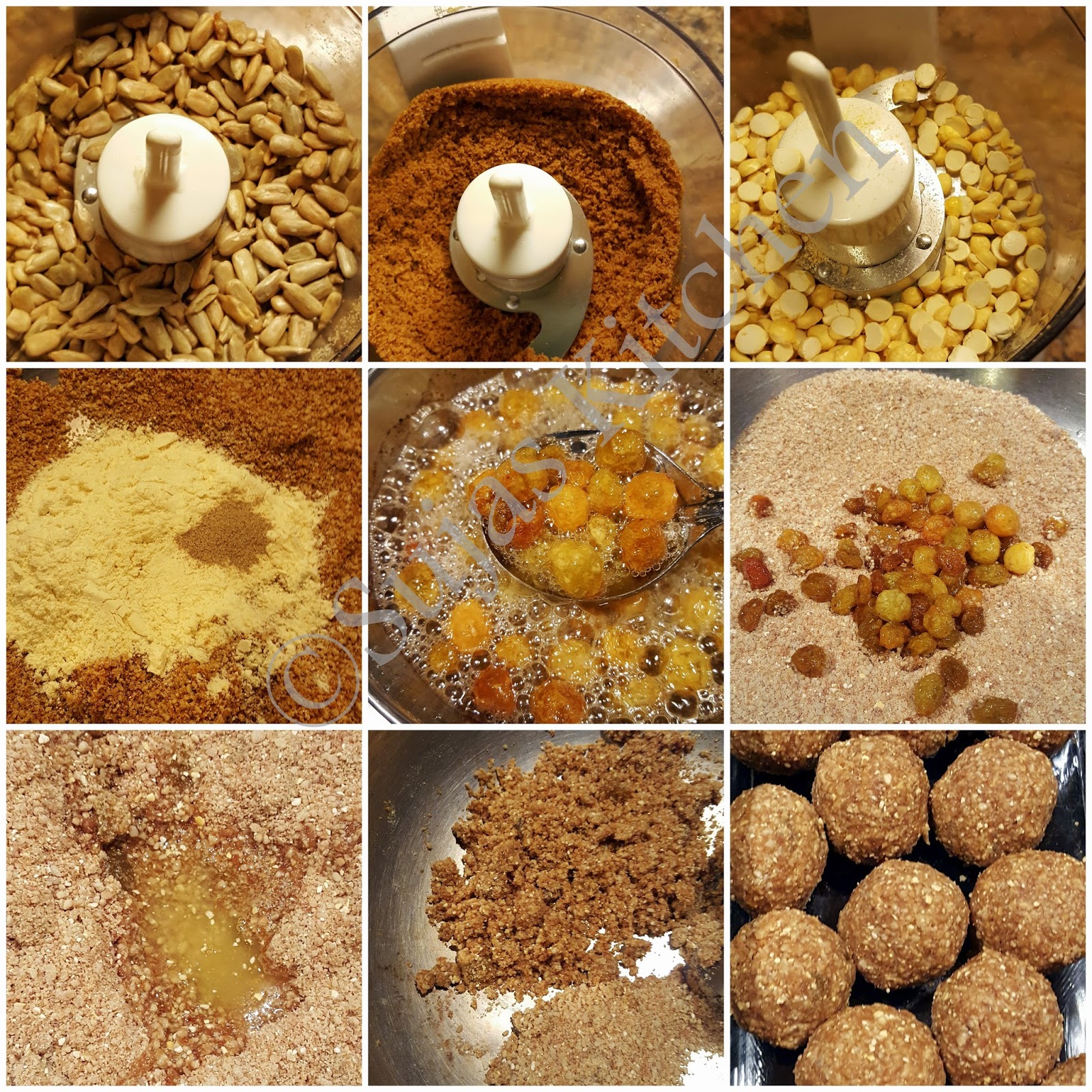
      Sunflower seeds are loaded with antioxidants.They are a good source of selenium, a proven enemy of cancer. They contain bone-healthy minerals and also contain Vitamin E, which helps ease arthritic pain. The Vitamin E in them brings a glow to your skin. A quarter cup of sunflower seeds a day can keep heart troubles away. With their crunchy, nutty taste, sunflower seeds can easily become a regular part of your daily diet and prevent food cravings. You can also sprinkle them on your salads, and stir-fries. I chew down on a handful of these seeds, during snack time to cut down on other cravings and to keep me satiated until meal time. I wrote down this recipe in my recipe diary, as I was making it so I could use up some of the sunflower seeds in my pantry.


Ingredients for about 15 ladoos:

1 cup of  roasted (unsalted) sunflower seeds
1 cup of powdered jaggery
1/2 cup of pottukadalai/roasted channa dal
1/2 tsp, cardamom/elaichi powder
1/4 cup of ghee
1/4 to 1/2 cup of raisins


Stovetop method:

  • If you have raw sunflower seeds, dry roast them on low heat until crisp, and aromatic. Let cool.
  • Dry grind in a food processor to desired coarseness. Transfer to a heat-resistant bowl.
  • Grind/powder crumbled jaggery to a fine powder; transfer to the bowl.
  • Powder the chutney dal finely & add to the rest of the powders. Add the cardamom powder & give it a stir.
  • Heat a small pan with the ghee & fry the raisins until plump. Add raisins to the powdered mixture & mix it in.

  • Continue to keep the ghee on very low heat. Add one ladle/spoon of hot ghee to one small portion of the sunflower seed, jaggery, chutney dal mixture. Blend the ghee with the nutty mixture & make firm balls with your fist. NOTE: Use only a small quantity of the powdered mixture to add ghee - make balls. These ladoos should not require much ghee as the sunflower seeds are oily in the first place.
  • Repeat the process until you have turned all of the powder into balls of your desired size.
  • Store in an air-tight container at room temperature & enjoy.

NOTES:

  • Roasted sunflower seeds are readily available in specialty food stores, if not in regular grocery stores.
Sharing this recipe with my fellow bloggers at Sri Valli's CCC# 51: November Week 3.


September 23, 2017

Easy Rawa Kesari

How to make easy Rawa Kesari 


              It just dawned upon me that there are many basic easy recipes that are missing from my blog like the humble Kesari. So here goes an easy method that doesn't require technical stirring & standing next to it for a long time for the dish to be complete. This recipe was inspired by the Rawa Pongal recipe by Mrs. Revathi Shanmugam. The technique is a little different here though. One important thing to note - If the rawa & the sugar water are not piping hot while mixing, it might get sticky & lumpy. My recipe makes a mildly sweet Kesari. You can increase the sugar to 1 cup if you like it sweeter. So here's a quick recipe for you to try this Navrathri season or just any time of the year.


Ingredients for about 6 servings:


          For the sugar syrup


·  3/4 cup sugar
·  1.5 cups water
·  1/8 tsp, cardamom/elaichi powder
·  a pinch of salt
  

  For roasting the rava

·  1/4 cup or 4 tbsp ghee
·  1/2 cup rawa /sooji
·  8-10 cashew-nuts, broken
.  1 tbsp, raisins (optional)


Easy Rawa Kesari

Stovetop method:

  • Take a heavy bottom pan or a pressure cooker and add the water, sugar, cardamom powder, and a pinch of salt. You can add saffron or food coloring if desired. Light the stove & let it heat. 
  • Set another pan on the stove over medium heat. Add in the ghee, cashew-nuts and the rawa and fry until golden & aromatic. The ghee will initially bubble up on the sides of the pan during roasting. Keep stirring and take care not to let it burn.

  • We will be working simultaneously using two stoves - when the sugar mixture comes to a rolling boil, the rawa will also be roasted. If the sugar mixture starts boiling before the rawa is roasted, just put the sugar mixture on simmer.
  • When the sugar mixture comes to a rolling boil, we are ready to add in the rawa. Carefully add in the roasted hot rawa slowly into the boiling sugar water mixture, taking care not to let the hot liquid splash on you. Immediately after adding rawa, mix well and cover the pan/cooker with the lid and switch off the heat. (If there are any vents on the lid, make sure you cover them with a kitchen towel or use the weight if using a pressure cooker – so we do not let the steam escape. 

  • Keep it covered tightly for about 20 minutes. After 20 minutes, open and mix the Kesari well. The rawa would have absorbed all the moisture and swelled up, glistening with ghee and totally lump free.
  • The Kesari is best served warm or at room temperature. You can store the Kesari in the fridge for up to a week.
Sharing this recipe from my diary with my fellow bloggers at SriValli's CCC #49 Sep Week 4.

August 25, 2017

Inippu Pidi Kozhukattai / Sweet Pidi Kozhukattai

How to make Inippu Pidi Kozhukattai / Sweet Pidi Kozhukattai


             Sweet Pidi Kozhukattai (also known as Vella kozhukattai or Inippu kozhukattai) is one of the traditional kozhukattai varieties that is the easiest & quickest you can make. These are like sweetened rice dumplings made with lentils, coconut, and jaggery. You can make these with store bought rice flour / kozhukattai flour /idiyappam flour. 


             As the name indicates, these kozhukattais are shaped with the grip of hands (Pidi) which gives them a rather distinct shape with finger impressions on them. For those who haven't tried making kozhukattai’s before, you can start with this one, as your chances of going wrong with this recipe are close to none. 


             Not only can this be made during Ganesh Chathurthi, but also as an evening snack for your family. It’s a perfectly healthy snack for kids since it is steamed. It is also gluten and dairy free. I learned this kozhukattai from my MIL & it comes from my recipe diary just for you.


Ingredients :

Rice flour - 3/4 cup
Powdered Jaggery/Palm Sugar - 1 cup
Grated Coconut- 1/2 cup
Salt - a pinch
Kadalai paruppu/Bengal gram dal - 1/4 cup (soaked in water for 20 mins)
Elakkai/Cardamom powder - 1/2 tsp
Cashew nuts, broken - 1 tbsp
Sesame/Gingelly oil - 2 tbsp
Water - as needed


Stove top method:

  • In a bowl, add the rice flour, salt, coconut, soaked bengal gram dal, cashew nuts and cardamom powder; mix dry & set aside.

  • Heat a thick bottomed pan with the jaggery and add about a 1/4 cup of water to it and make a thin syrup. When all the jaggery melts, filter it for impurities and pour it back into the pan.
  • Heat the pan with filtered thin syrup add oil, stir & add the rice flour mixture in installments stirring it in-between to ensure there are no lumps for about a minute. If the liquid is not enough for the flour, sprinkle some water until you get a thick dough consistency, that does not stick to your fingers.

  • Turn off the heat & transfer to a bowl & keep covered (so it doesn't dry). Lightly dip your fingers in gingelly oil when you make bite sized balls or oval-shaped kozhukattai's with your finger impressions on it.

  • Grease idli plates or any other container & arrange the kozhukattai's in a single layer, steam them for about 12 minutes on medium heat. 
  • Serve warm or at room temperature.


Notes:

  • If the liquid is not enough for the flour, sprinkle some water until you get a thick dough consistency, that does not stick to your fingers.
  • You can substitute moong dal for bengal gram dal and Karupatti (dark palm sugar) or brown sugar for jaggery.
  • It can also be made without using any oil if needed but can be a little dry with cracked texture.
  • If refrigerated, steam for few minutes, so it turns soft prior to serving.

Sharing this recipe with my fellow bloggers at Sri Valli's CCC #47 August Week 4.


July 30, 2017

Varutha Arisi Sojji / Roasted Rice Upma

How to make Varutha Arisi Sojji / Roasted Rice Upma


            Most households probably get around to making two or three kinds of upma's - semiya upma, arisi rava upma & wheat rava upma. This was new to me when my MIL made this for dinner the first time. Her story behind this goes like this - during her childhood days, her mom used to make this as a quick and low-cost meal to serve a large family living on a budget. 

            This can be a lunch box recipe (stays fresh) or can be breakfast/dinner. This can be served with Milagai podi, Chutneys/Thuvayals, Sambhar, or Gothsu. This family (MIL) recipe comes from my recipe diary & is being shared with SriValli's CCC#46 July week #4.


Ingredients for 3 servings:

Pacharisi/Raw rice - 1.5 cups
Paasiparuppu/Green gram dal - 1/2 cup
Salt to taste
Grated coconut - 3 tbsp
Crushed black pepper  - 1 tsp
Water - 1 cup (for dal) + as needed to cook your rice
[ I used, 1(rice) : 3(water) ratio ]

For thalippu/tempering:

Oil - 2 tbsp
1/2 Tsp mustard seeds
2 tsp, kadalai paruppu/bengal gram dal
Dry red chilies - 3, broken
1 tsp, jeera/cumin seeds
a pinch of asafoetida powder
a sprig of curry leaves


Stove top method:

  • Dry roast the dal & rice separately in a dry kadai/pan, until slightly golden, crisp & aromatic.
  • Heat the oil in a large cooker/kadai and add the ingredients listed for tempering one by one & fry for a few seconds, taking care not to burn them.
  • Pour the required amount of water for the dal & rice to cook, add salt & let it come to a boil.
  • When the water begins to boil, add the roasted rice, and dal. Cover & let cook on medium until rice & dal are cooked soft. (If using pressure cooker, use the weight & let cook for about 10 minutes or 2 whistles)
  • Sprinkle crushed pepper powder, add grated coconut, give it a stir and turn off the heat. 
  • Serve hot with Kathirikai gothsu or try any of these thuvayals or chutneys.


July 23, 2017

Mangai Sadham / Mango Rice

How to make Mango Rice/Mangai Sadham


            Manga sadham/Mango rice is one of the lip smacking rice of the south. This recipe brings back nostalgic childhood memories. Sneaking up to the terrace when the adults are busy taking an afternoon nap - find the biggest green mango that you can reach - pluck - take a bite - wait for it & make a sour face literally. On other occasions, it would be sliced and sprinkled with salt & paprika for a sour & spicy treat.
            The sourness of the rice will depend on how sour your mango is.  Serving this with Karivepillai thayir pachadi a.k.a Curry leaves raitha. The two flavors play well together.If you are a skeptic about the combo, try it before you dismiss the idea. 


Ingredients for 4 servings


1 large unripe/green mango
1 cup uncooked rice, cooked but not mushy
2 tbsp sesame oil
1/2 Tsp, chili powder
2 dry red chilies, broken
1 teaspoon mustard seeds
a pinch of asafoetida powder
a sprig of curry leaves
1/4 Tsp turmeric powder
1/4 Tsp roasted & powdered fenugreek seeds (optional)
Salt to taste


Stove top method:

  •  Fluff the cooked rice gently, mix in a tbsp of sesame oil & spread the rice on a plate and let it cool. 
  • Grate the mango, peeled or unpeeled.Heat remaining oil in a pan and when it's hot, add mustard seeds and fry for 30 seconds.Add curry leaves, dry red chilies and asafoetida powder cook for a minute. Add turmeric powder, fenugreek powder (if using),  grated mango, salt, and cook for a few minutes on medium heat, until the raw smell of the chili powder is gone.
  • Turn off the heat, add the cooled rice and mix gently. Check seasoning & serve with papad & curry leaves raitha.


June 19, 2016

Masala Lemon Rice

How to make Masala Lemon Rice


              I usually make lemon rice, with green chillies & ginger (see recipe - Lemon-Lime Rice) which needs no grinding of ingredients. Once in a while, I like to make this masala lemon rice which has ground fenugreek seeds & red chillies in it for a different flavor. This lemon rice reminds me of the kovil prasadam aka temple offering, back home. So give this recipe a try and evoke nostalgic feelings of your temple visits. Sharing this recipe with my fellow bloggers at CCC# 33: June-Week 3.

          That makes me ponder - we hardly realize that the present moment is special, in that moment (during the actual experience). We yearn for it only after we lose it or go far away from the experience. And, when that happens, even a daily/ordinary happening becomes close to our heart and we long for that experience again. I'm beginning to understand the importance of all the spiritual quotes I've read about being fully present in the moment. 
                                                     
  Live in the present. - Dalai Lama

Wherever you are, be all there.  - Jim Elliot

Realize deeply that the present moment is all you ever have. - Eckhart Tolle

The present moment is the only moment that's available to us, and it is the door to all available moments. - Thich Nhat Hanh


January 15, 2016

Sakkarai (Sweet) Pongal

How to make Sakkarai/Sweet Pongal (Pressure Cooker Method)


                Happy Pongal, everyone!! I guess, everyone has their favorite version of the Sakkarai Pongal. There are numerous combinations/ratios/ingredients/methods to try from and you will still get a yummy Pongal, no matter what. So, here's my very own version of one of my favorite Pongal's, from my recipe diary, which uses, milk & unsweetened khoa apart from the usual ingredients. 

               Along with the recipe, I'm also sharing a Kolam (poster board size), I drew for a Pongal function. Before you scroll down, let me confess, that I'm no artist & have tried drawing this one after 15 years. This kolam is probably a child's play for many of you. I salute all the wonderful Kolam experts out there :o) (More about Kolams) 


Sakkarai, Paal  Pongal, Innippu Pongal, Sweet pongal with Milk & khoa


16 by 16 dots pongal paanai kolam (neli kolam/border - additional dots)


Sakkarai, Paal  Pongal, Innippu Pongal, Sweet pongal with Milk & khoa


October 16, 2015

Karuppu Ulundhu Sundal

How to make Karuppu Ulundhu Sundal / Whole Black Lentil Snack


         When Navarathri comes around, the first things that cross my mind are Golu, Paatu, Pattu, Sundal & a goody bag of auspicious stuff, along with a one rupee coin :o)  Every house we visit will serve a bowl of warm Sundal. Although delicious, the kids could only eat so many bowls of Sundal. So we would take home the remaining Prasadham to share with our families.

                Navarathri brings along its own share of sweet memories from childhood. It is probably the only time of the year when kids are invited with respect/importance; by grown ups, who normally wouldn't have anything to say to you; except "Where's your Amma"? or "Where's your Patti"? I would come home from school; eager to dress up in pattu pavaadai's & wear some real jewelry (finally!!) and go to almost every house on our street to see their seven or nine step arrangements of beautiful dolls & idols; that are strategically organized in to groups & categories.  Kids, mostly girls would be asked to sing songs in praise of the gods & goddesses. The funny part is, when a girl is singing, there would be so much activity going on around her; It almost feels like no one is paying attention to her song. So much for the respect, I thought we were getting...LOL!!

                 This was probably my first Sundal recipe that was written down in my recipe diary, when I only knew, how to eat :)


How to make Karuppu Ulundhu Sundal/ Whole Black Lentil Snack


April 30, 2013

Lemon-Lime Rice

How to make Lemon-Lime Rice

         The Lemon Rice as we know it has taken a turn for the better in this Bold & Tangy Lemon-Lime Rice!! I have been making my Lemon rice this way as my family likes its bold flavor. I prefer not to use Basmati rice, as the flavor of Basmati doesn't compliment this dish.

         This is excellent for picnics, travel, lunch boxes and Valaikkappu (Indian Baby Shower). I bet the pregnant ladies would love this tangy rice. It can be served with Potato fry / pickles / chips or pappad.


Lemon Lime rice


Related Posts Plugin for WordPress, Blogger...