Showing posts with label South Indian. Show all posts

August 22, 2019

Kalkandu (Rock Sugar) Pongal

How to make Kalkandu (Rock Sugar) Pongal


            The jaggery pongal is quite popular & well liked by everyone, but the kalkandu pongal is kind of like the shy cousin of the jaggery pongal. Many may not have tasted it and hence not know about this less known , but equally delicious pongal version. The recipe was duly noted in my recipe diary cos' my grandma & mom used to make this pongal occasionally. To make this pongal taste rich, I have used evaporated milk instead of regular. Sharing this divine recipe with my friends at Sri Valli's CCC# 41: February -- Week 2.


Ingredients for 6 to 8 servings:

uncooked rice - 1 cup
Pasiparuppu/Moong dal - 1 tbsp
Kalkandu/Rock sugar - 1.5 cups
Evaporated milk or regular milk - 1 cup + 2 tbsp
Elakkai podi/Cardamom powder - 1/4 tsp
Nutmeg powder - 1/8 tsp
Ghee - 3 tbsp
Saffron - a pinch
Raisins - 1 tbsp or more
Cashewnut - 2 tbsp


Pressure cooker method:

  • In a pressure cooker, cook (until soft & mushy) the rice & dal together with 1 tbsp of ghee, and excess water. (ex: if you normally add 2.5 cups of water for 1 cup of rice; add 3 cups of water instead).
  • Soak the saffron in 2 tbsp of warm milk.
  • When the rice is cooked, add the kalkandu/rock sugar to it, stir to let it melt in the heat. Add the milk & stir on low heat, taking care not to burn it.
  • Add cardamom and nutmeg powder. Add the soaked saffron to the pongal.
  • In a separate pan, melt ghee & fry the cashewnuts & raisins. Toss them into the pongal & serve hot or cold.


October 28, 2018

Nuts & Wheat Ladoo

How to make Nuts & Wheat Ladoo


              Also known as Atte ka Ladoo in Hindi (can also be made without nuts) is a simple Indian sweet made with basic ingredients from our pantry. A great after workout snack or a health-boosting dessert alternative. They make great homemade treats instead of store-bought processed snacks. These delicious balls are jam-packed with flavor and nutrients. These ladoos being high in calories are great for kids to keep their energy levels up any time of the day.


Ingredients for about 40 ladoos:


whole wheat flour - 3 cups
Cashew nuts - 1/2 cup
Pistachios - 1/4 cup
Almonds - 1/4 cup
(superfine) Sugar - 2 cups
Cardamom powder - 1/2 tbsp
melted ghee - as needed to make ladoos


Stove-top method:

  • Dry roast all nuts in low flame for 2-3 minutes, until the raw smell disappears. Let it cool down & powder them finely and set aside.
  • Dry roast the wheat flour on low heat until it loses its raw flavor and smells aromatic. 
  • If your sugar is not super fine, you may powder it before adding it to the flour.
  • Add the powdered nuts, sugar, cardamom powder to the roasted flour, and mix it well. Melt ghee on low flame & keep it warm, until you finish making all ladoos.


  • Take a small batch of the flour mix, pour a ladle full of hot ghee, stir & make balls using your hand. Repeat the process until all of the flour has been turned into ladoos. 
  • Store in air-tight container & enjoy with your family & friends.

Sharing my mom's recipe from my recipe diary with my friends at CCC #59 Oct Week 4.


August 26, 2018

Sorakkai/Bottle Gourd Halwa

How to make Sorakkai/Bottle Gourd Halwa

             
            This was the very first sweet that I ever made, probably in my late teens. I remember my great grandma watching me fumble my way through the steps of the recipe that I had written down possibly from a Tamil magazine or newspaper. What I liked about this recipe is that it uses the basic ingredients that would already be available in an average Tamil household in that time period & does not ask for mawa or food colors etc. Of course, if you like you can substitute evaporated milk, mawa or food colors as you like. I have tweaked the recipe by using the pressure cooker to speed up the process. Do try this easy recipe & enjoy.


Ingredients for about 4 servings

1 large sorakkai/bottle gourd- 5 cups grated/minced
3/4 cup sugar
1 cup evaporated milk/regular milk
1/4 tsp cardamom powder
A pinch of turmeric powder
A pinch of salt

For frying

1 tbsp ghee
A few cashewnuts


Stovetop method

  • Wash, peel, remove the seedy area & finely mince the bottle gourd in a chopper. You can also use a grater & grate the bottle gourd. Squeeze out the juice and set aside as we will not be using it in the recipe.

  • Heat a pressure pan on medium heat, add the minced/grated bottle gourd, a cup of milk & 3/4th of a cup of sugar. Stir, close, add the whistle & let cook on medium heat for three whistles. When done, let the steam out manually or naturally. Add turmeric powder, cardamom powder, salt & keep stirring occasionally until all the liquid evaporates. 

  • Meanwhile heat a tiny pan with ghee, fry the cashews until golden brown & add it to the halwa when most of the liquid has evaporated. 

  • Simmer for a few minutes until you get halwa consistency & serve warm or cold.

Sharing this simple yet delicious recipe with my fellow bloggers at SriValli's CCC #57 Aug Week 3.

August 17, 2018

Kathirikai Paal Curry/ Curried Eggplant in Coconut milk

How to make Kathirikai Paal Curry 


                This recipe has been in my recipe diary for many years now and has finally made it to the blog. Thanks to the influence my recent trip to Srilanka has had on me for dishes made with coconut milk. Let us talk more about my trip in a later post. I have had a love affair with coconut milk since childhood. The sweet, creamy & delicious milk is hard to resist after all. Let's jump straight to the recipe before I go way off topic here. A little bit of this milk can make a world of difference to your dish. Do try this recipe & enjoy.


Ingredients (3 servings):

small violet brinjals, sliced - 5 no:s
chopped onions - 1 no:
curry leaves - a few
chopped tomatoes - 1 no:
ginger garlic paste - 1 tsp
thick coconut milk - 1/4 cup
oil - 1 tbsp
mustard seeds, cumin seeds - 1/2 tsp each.
red chili powder/paprika - to taste
salt - to taste


Stovetop method:

  • Heat a pan with 1 tbsp oil, add mustard, cumin seeds & curry leaves. Once the mustard pops, add the chopped onions & saute until translucent.
  • Add chopped tomatoes, ginger-garlic paste & let cook for a couple of minutes & follow with turmeric powder, red chili powder & salt. Add the sliced brinjals and half a cup of water, cover & let the brinjals cook until tender, but not mushy.
  • Finally, add the coconut milk (thick milk) & let simmer for a couple of minutes, before you serve it with rice, roti or even dosa.

Sharing this with my fellow bloggers at CCC #57 Aug Week 3. Have a look around, you might like some of their recipes too.


May 27, 2018

Vepampoo (Neem Flower) Rasam

How to make Vepampoo (Neem Flower) Rasam


            Vepam Poo Rasam/Neem flower Rasam is an aromatic rasam made using neem blossoms (also known as the Indian Lilac) & ghee which is usually prepared for Tamil Puthandu/New Year. Puthandu is the day of new beginnings. This day is celebrated by Tamilians with neem flowers and raw mangoes to symbolize growth and prosperity. Intake of the Neem flowers once in a month is highly recommended to cleanse our digestive system. This Tamilian recipe can be served along with Steamed Rice, Poriyal & Appalam/chips.

                I learned this recipe from my MIL and love the flavor of the neem flowers roasted in ghee which makes it super aromatic & satisfying. There are a few variations you can do in this recipe, see notes below. Check out my other Rasam Varieties too.


Ingredients:

Lemon sized, Tamarind - soak, strain & make tamarind extract 
Rasam powder -2 Tbsp
Salt to taste
Turmeric powder - 1/4 Tsp

For Tempering:

Mustard seeds - 1 Tsp
Curry leaves - 2 Sprigs
Asafoetida - a pinch
Ghee - 1 Tsp + 1 Tbsp
Picked, washed & dried, Neem flowers/ Vepampoo - 2 Tbsp
3 Dry Red Chilies, broken


Stovetop Directions:

  • Heat the 1 tsp of Ghee & fry the Mustard seeds, Red Chilies, Asafoetida, Curry leaves. Add the remaining ghee, fry the Neem blossoms until dark brown, crisp & aromatic (but don't let it turn black).

  •  In a different pan, heat the tamarind extract with Turmeric powder, Salt, Rasam powder & boil it just until it froths & turn off the heat.

  • Finally add the tempered ingredients to the boiled tamarind mixture & serve hot, with a south Indian meal platter.

Notes:

  • You can opt for the following in your recipe if you like - chopped tomatoes or cooked toor dal.
  • You can omit rasam powder & increase chilies if you like too.
  • Frying the neem flowers in ghee is to reduce the bitterness.
 Sharing this from my recipe diary in SriValli's CCC# 55: May - Week 4.


May 20, 2018

Hyderabadi Colocasia/Arbi Roast

How to make Hyderabadi Colocasia/Arbi Roast (Fried & No fry method)

                      
            Colocasia, Arbi, Taro, Seppankizhangu are just a few ways to call this tasty tuber. This is an easy and delicious side with masala coated cubes of Arbi. Although this recipe calls for frying the colocasia, scroll down all the way to see the no-fry method using the same ingredients for a low-calorie version without compromising on flavor. This Nawabi cuisine recipe is from chef Venkatesh Bhatt. I have given his exact recipe as well as my version of the low-calorie, no fry recipe here. You can try both versions or just pick your style & go with it. 


Ingredients:

4 to 6 whole Seppankizhangu/Colocasia
2 slit green chilies
Coriander powder - 1/2 Tbsp
Turmeric powder - 1/4 Tbsp
Chili powder - 3/4 Tsp
Tamarind water - 1/4 Cup
Salt to taste
Cumin seeds/Jeera - 1/2 Tsp
Garam masala powder - 1/2 Tsp
Ghee/Clarified butter - 2 Tsp
Oil - as needed
Chopped Coriander leaves - for garnish


Stovetop Directions:


  • Boil colocasia immersed in water for 15 minutes or pressure cook for two whistles. Let cool, peel the skin & make cubes of the desired size.
  • Fry the colocasia cubes in hot oil until crisp & forms a golden brown crust. Remove from oil onto an absorbent paper.


  • Heat 2 Tbsp of oil on medium heat in another pan, add cumin seeds, green chilies, coriander powder, chili powder, turmeric powder, garam masala powder and saute until the raw smells disappear. Now add the tamarind water, let simmer until it is cooked & thickened. Finally, add the fried colocasia give it a toss, drizzle some ghee & let roast (opened) for a few minutes on low heat.

  • Remove from heat & garnish with chopped coriander leaves. Serve with your favorite meal platter & enjoy.


No-Fry Arbi Roast Method -

  • For the low-calorie (no fry) version of the recipe - Boil/cook the colocasia until soft, peel & cube into medium pieces. Skip the frying part. Heat 3 tbsp of oil in a pan, add cumin seeds, chopped onion (optional), coriander powder, chili powder, turmeric powder, garam masala powder and saute until the raw smells disappear. Now add the tamarind water, let simmer until it is cooked & thickened. Finally, add the cubed colocasia give it a toss, drizzle some ghee & let roast (opened) for a few minutes on low heat. Remove from heat & garnish with chopped coriander leaves. Serve with your favorite meal platter & enjoy.


           Sharing this recipe with my fellow bloggers at Valli's CCC# 55: May Week 3. Do check out the other recipes at CCC.


March 25, 2018

Poricha Kootu / Kuzhambu

How to make Poricha Kootu / Kuzhambu


                 Kootu is a typical Tamilian side dish. This is a medium thick stew made with dal, vegetables, and a coconut based spice mix. This version is called "Poricha Kootu and it's one of the many healthy dishes from the South Indian cuisine. There is another version of this which is made with lots of garlic, ideal for lactating moms. Be sure to check the notes on the bottom for other variations of this dish. Serve it with rice, a side of pickle and papad. This being my mom's recipe, that I had written down a long time ago comes from my recipe diary for this  CCC# 54: Mar Week 4.


Ingredients:

Ash Gourd/Vellai Poosani, peeled & cubed - 250 gms
Onion, chopped - 1 (Optional)
Tomatoes, diced - 2 no:s
Toor dal - 1 cup (cooked soft)
Turmeric powder - 1/4 tsp
Salt to taste
Oil - 1 Tsp
Mustard seeds - 1 tsp
Urad dal - 1 Tbsp
A sprig of curry leaves
Half a lemon's juice (optional)


For the masala:

Roast and grind the following into a fine paste.
Oil - 1 tbsp
Dry red chilies - 2 no:s
Urad dal - 1 Tsp
Cumin seeds - 1 Tbsp
Coconut  pieces or grated - 1 cup


Stovetop method:

  • Pressure cook the Toor dal until soft with 2 cups water and a few drops of oil and set aside.
  • Heat a pan over low-medium heat and add all the ingredients listed in the masala group except the coconut and saute until golden crisp and fragrant. Finally, add the coconut & saute for a few mins. Let cool, add a little water and grind into a fine paste.


  • Heat a larger pan with a tsp of oil, add mustard seeds, urad dal, curry leaves and saute until golden brown. Add chopped onions to the pan and saute for a while. Add the tomatoes, ash gourd, salt, turmeric powder and water; cover & cook until the ash gourd is soft. Add the ground masala paste, cooked Toor dal and let boil for two minutes and remove from heat.

  • Optionally, you can squeeze half a lemon into it after the Kootu has cooled down a bit. 
  • Serve hot with steamed rice and your favorite sides.

Notes: 

  • You can use a mixture of Toor dal & yellow moong dal for variety.
  • A variation of this kuzhambu is made with lots of garlic, ideal for lactating moms.
  • The ash gourd can be substituted with any country vegetables like brinjal, chow-chow, pumpkin, bitter gourd, snake gourd, drumstick, broad beans or a combination of veggies.
  • By diluting the recipe to have lesser vegetables & more gravy you can achieve the Kuzhambu consistency. 
  • Vengaya vadakam can be fried and added at the end for an aromatic finish.

February 23, 2018

Broken Wheat Tomato Dosa (No Fermentation Required)

How to make Broken Wheat Tomato Dosa


         How many times have you heard whining & complaining from your family members when they hear that they will be served the ever so popular Upma for breakfast/dinner? I was fed up with hearing all the whining (majorly coming from the man of the house) and sang 'Hallelujah' when I came across this recipe to use up the bag of broken wheat that was sadly sitting in my pantry. Thanks to Mrs. Revathi Shanmugam cookbook for this quick no fermentation recipe. 

         I so wanted to deform the broken wheat into an unrecognizable batter before the big baby got home for dinner, but there he was staring into the bowl of soaked broken wheat & making a face which meant that he was even more afraid of the rawa now :)

         This dosa stayed soft for a few hours (with use of oil) and can be packed for kids lunches too. Sharing this easy, healthy & tasty recipe with my friends at SriValli's CCC# 54: Feb -- Week 4.


Soaking time - 1 hour
Fermenting time - None 
Serves - 2 to 4 


godumai rawa/broken wheat - 1 cup
thakkali/tomatoes - 2 no:s
green chilies or dry red chilies - 2 no:s
inji/ginger - 1 inch long
karivepillai/curry leaves - a sprig (optional)
kothamalli/coriander leaves - as per taste
salt to taste
oil as required to make dosa


Method:

  • Soak the broken wheat in enough water for about an hour. 
  • In a blender/grinder add the ginger, chilies, curry leaves, coriander leaves and tomatoes and grind to a fine puree. If you have room add drained rawa to the puree & grind to a medium fine consistency. (by following this way, we can avoid adding more water for grinding). If you need to grind the wheat rawa separately, only use minimal water as needed so the dosa batter doesn't become too runny. Add salt to taste & transfer batter into a container.


  • Heat a tawa/pan on medium high & pour a laddle full of the batter & make a circular dosa as thin as possible. Drizzle a few drops of oil around the edges & cook for a minute & flip it over to cook the other side for a few seconds and enjoy with your favorite side. Enjoy the dosas with Potato Masala, Chutney varieties, Sambhar or Milagai podi.

February 4, 2018

Inji Kara kuzhambu

How to make Inji Kara Kuzhambu (ginger in spicy tamarind sauce)


         On a cold rainy day, many of us crave for some spicy comfort food. Our morning started with snowflakes, changed into sleet & then rain. So, I decided to make this recipe from my recipe diary ( a recipe noted from a TV show years ago). The lady mentioned that the recipe was originally from Pondicherry(Puducherry), located in the southern part of India.

        Serve it with hot steamed rice, and appalam/papad or chips and you have a zesty meal to make you feel warm & fuzzy on any given day. It is a spicy dish, so go easy & drizzle some sesame oil on your rice to make it even tastier.


Ingredients:

Servings: about 4

nalla ennai/sesame oil - 2 tbsp
poondu/garlic - 5 pods
perungayam/asafoetida powder- 1/4 Tsp
manja thool/turmeric powder - 1/4 tsp
Puli/Tamarind - 1" sized ball soaked in water & strained with minimum amount of water
vengaya vadagam - 1 tbsp
karivepilai/curry leaves - 1 sprig
salt to taste
vellam/jaggery - 1 tbsp, powdered (optional)
coriander leaves - optional


Ingredients for the masala:

nalla ennai/sesame oil - 2 Tsp

Group 1
milagu/black pepper - 1tsp
Jeerakam/cumin seeds - 1 tsp
milagai/dry red chilies - 5 no:s

Group 2
poondu/garlic - 5 pods
inji/ginger - about 2 inches, sliced

Stovetop method:

For the masala - 

  • Heat a pan/kadai with a tsp of sesame oil, add group one ingredients & saute in oil until crisp & aromatic. Transfer contents to the mixie/blender jar & let cool for a couple of minutes.
  • Reheat the pan, add group 2 ingredients & saute on medium-low heat until well roasted & soft.
  • Powder roasted group 1 ingredients finely & then add sauteed group 2 ingredients & run the mixer/blender for a couple of seconds to make a coarse paste.

To make the kuzhambu -

  • Heat oil in a kadai/pan, add asafoetida powder, vengaya vadagam & let it fry until crisp. Add few curry leaves & garlic pods - saute until garlic is golden brown & cooked soft.
  • Using a little water, wash the mixie/blender & add the ground masala to the kadai, pour the strained tamarind water, add turmeric powder, salt & jaggery(if using). Let simmer for a few minutes on low heat.

  • Check seasoning, drizzle some sesame oil on top and turn off the heat.
  • Serve with steamed rice & papad/chips. Can also be eaten with paruppu podi or Karivepillai podi.
Sharing this tangy recipe with my fellow bloggers at SriValli's CCC Feb #53 -- Week 1.


November 19, 2017

Quick Sunflower seeds Ladoo

How to make Sunflower seeds Ladoo


      Sunflower seeds are loaded with antioxidants.They are a good source of selenium, a proven enemy of cancer. They contain bone-healthy minerals and also contain Vitamin E, which helps ease arthritic pain. The Vitamin E in them brings a glow to your skin. A quarter cup of sunflower seeds a day can keep heart troubles away. With their crunchy, nutty taste, sunflower seeds can easily become a regular part of your daily diet and prevent food cravings. You can also sprinkle them on your salads, and stir-fries. I chew down on a handful of these seeds, during snack time to cut down on other cravings and to keep me satiated until meal time. I wrote down this recipe in my recipe diary, as I was making it so I could use up some of the sunflower seeds in my pantry.


Ingredients for about 15 ladoos:

1 cup of  roasted (unsalted) sunflower seeds
1 cup of powdered jaggery
1/2 cup of pottukadalai/roasted channa dal
1/2 tsp, cardamom/elaichi powder
1/4 cup of ghee
1/4 to 1/2 cup of raisins


Stovetop method:

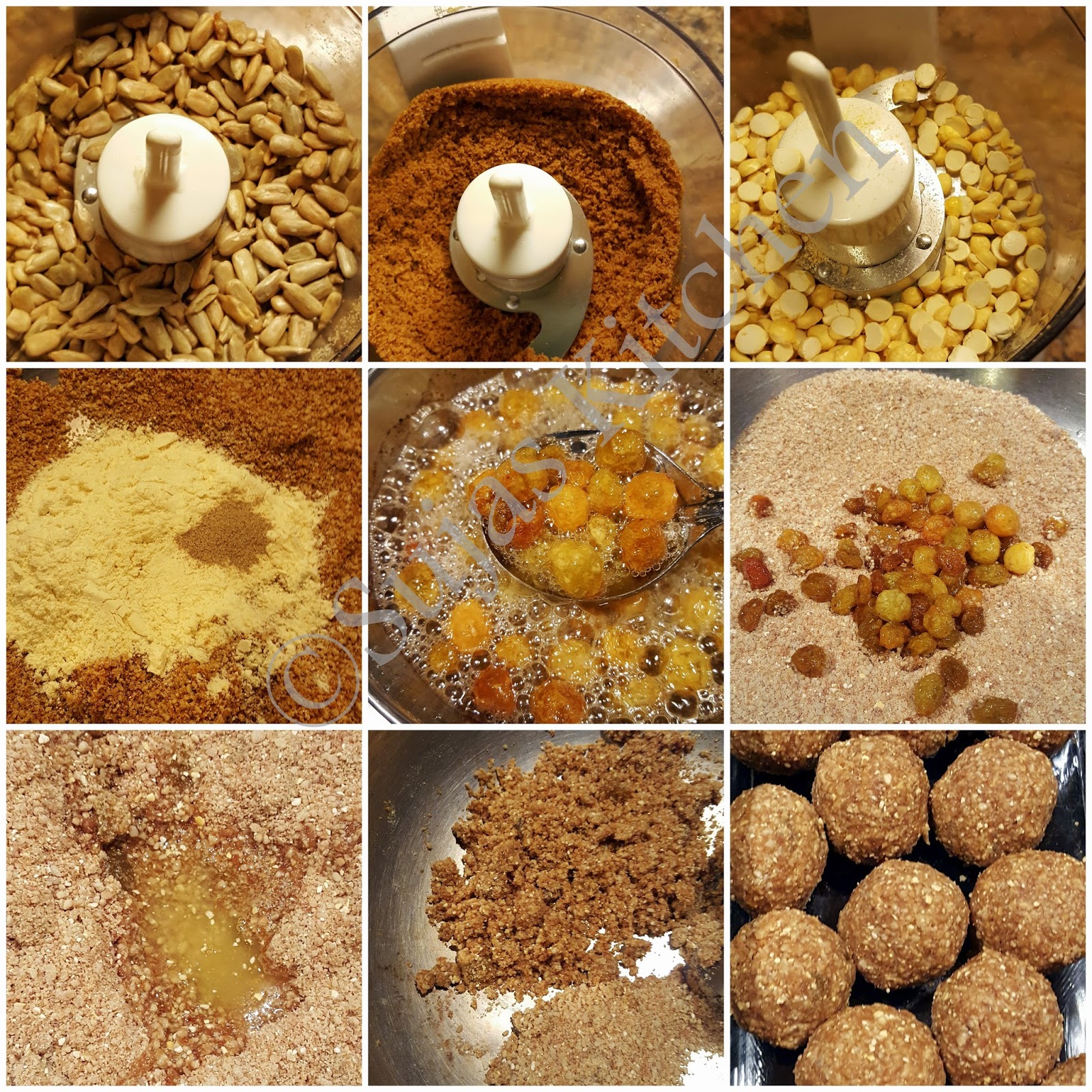
  • If you have raw sunflower seeds, dry roast them on low heat until crisp, and aromatic. Let cool.
  • Dry grind in a food processor to desired coarseness. Transfer to a heat-resistant bowl.
  • Grind/powder crumbled jaggery to a fine powder; transfer to the bowl.
  • Powder the chutney dal finely & add to the rest of the powders. Add the cardamom powder & give it a stir.
  • Heat a small pan with the ghee & fry the raisins until plump. Add raisins to the powdered mixture & mix it in.

  • Continue to keep the ghee on very low heat. Add one ladle/spoon of hot ghee to one small portion of the sunflower seed, jaggery, chutney dal mixture. Blend the ghee with the nutty mixture & make firm balls with your fist. NOTE: Use only a small quantity of the powdered mixture to add ghee - make balls. These ladoos should not require much ghee as the sunflower seeds are oily in the first place.
  • Repeat the process until you have turned all of the powder into balls of your desired size.
  • Store in an air-tight container at room temperature & enjoy.

NOTES:

  • Roasted sunflower seeds are readily available in specialty food stores, if not in regular grocery stores.
Sharing this recipe with my fellow bloggers at Sri Valli's CCC# 51: November Week 3.


September 23, 2017

Easy Rawa Kesari

How to make easy Rawa Kesari 


              It just dawned upon me that there are many basic easy recipes that are missing from my blog like the humble Kesari. So here goes an easy method that doesn't require technical stirring & standing next to it for a long time for the dish to be complete. This recipe was inspired by the Rawa Pongal recipe by Mrs. Revathi Shanmugam. The technique is a little different here though. One important thing to note - If the rawa & the sugar water are not piping hot while mixing, it might get sticky & lumpy. My recipe makes a mildly sweet Kesari. You can increase the sugar to 1 cup if you like it sweeter. So here's a quick recipe for you to try this Navrathri season or just any time of the year.


Ingredients for about 6 servings:


          For the sugar syrup


·  3/4 cup sugar
·  1.5 cups water
·  1/8 tsp, cardamom/elaichi powder
·  a pinch of salt
  

  For roasting the rava

·  1/4 cup or 4 tbsp ghee
·  1/2 cup rawa /sooji
·  8-10 cashew-nuts, broken
.  1 tbsp, raisins (optional)


Easy Rawa Kesari

Stovetop method:

  • Take a heavy bottom pan or a pressure cooker and add the water, sugar, cardamom powder, and a pinch of salt. You can add saffron or food coloring if desired. Light the stove & let it heat. 
  • Set another pan on the stove over medium heat. Add in the ghee, cashew-nuts and the rawa and fry until golden & aromatic. The ghee will initially bubble up on the sides of the pan during roasting. Keep stirring and take care not to let it burn.

  • We will be working simultaneously using two stoves - when the sugar mixture comes to a rolling boil, the rawa will also be roasted. If the sugar mixture starts boiling before the rawa is roasted, just put the sugar mixture on simmer.
  • When the sugar mixture comes to a rolling boil, we are ready to add in the rawa. Carefully add in the roasted hot rawa slowly into the boiling sugar water mixture, taking care not to let the hot liquid splash on you. Immediately after adding rawa, mix well and cover the pan/cooker with the lid and switch off the heat. (If there are any vents on the lid, make sure you cover them with a kitchen towel or use the weight if using a pressure cooker – so we do not let the steam escape. 

  • Keep it covered tightly for about 20 minutes. After 20 minutes, open and mix the Kesari well. The rawa would have absorbed all the moisture and swelled up, glistening with ghee and totally lump free.
  • The Kesari is best served warm or at room temperature. You can store the Kesari in the fridge for up to a week.
Sharing this recipe from my diary with my fellow bloggers at SriValli's CCC #49 Sep Week 4.

Related Posts Plugin for WordPress, Blogger...